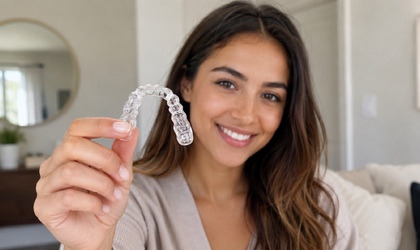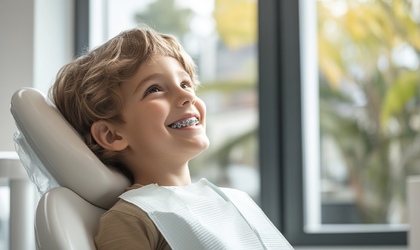
An overbite is corrected with orthodontic treatment, usually braces or clear aligners, which move your teeth into a better bite. Growing children may also use a palate expander or headgear, and in severe cases involving the jaw, surgery may be needed alongside braces.
The right method depends on two things: how deep your overbite is and how old you are. A mild overbite in a teenager is straightforward to correct, while a severe one in an adult takes more work. The encouraging part is that almost every overbite can be improved at any age.
What Is an Overbite, and How Severe Is Yours?
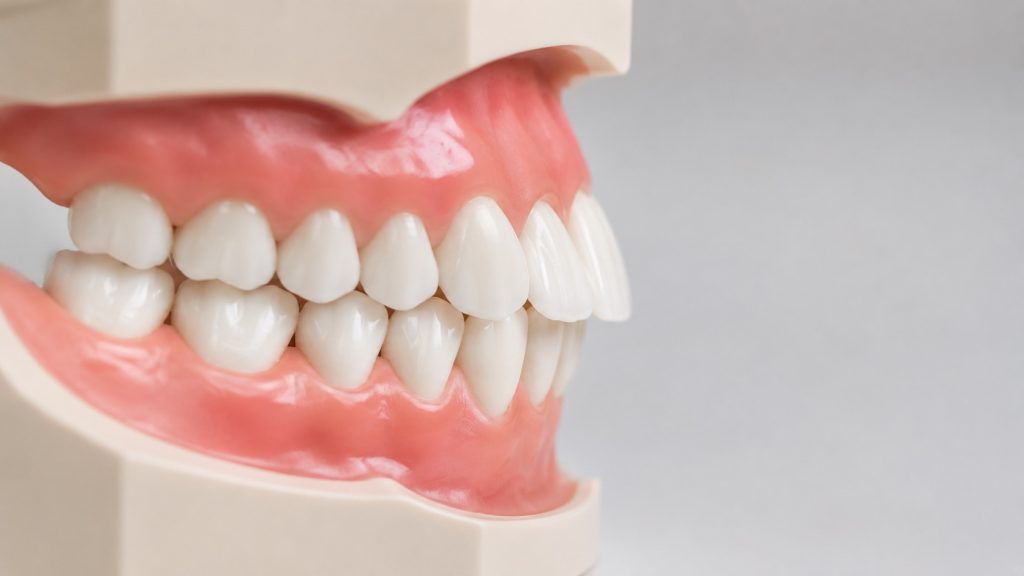
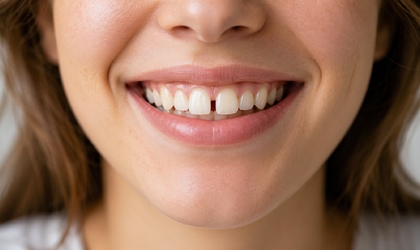
An overbite is when your upper front teeth overlap your lower front teeth too much as you bite down. A small overbite is normal and healthy, and it only becomes a problem when the overlap grows too deep.
Orthodontists often describe an overbite as a percentage, meaning how much of your lower front teeth the upper teeth cover. An overlap of about 10% to 30% is considered normal, while anything above roughly 50% is called a deep bite.
At 90% to 100%, the overbite is severe. A 100% overbite means your upper teeth almost completely hide your lower front teeth, and the lower teeth may even bite into the roof of your mouth.
This is different from an overjet, where the upper teeth stick out forward and are often called buck teeth. An overbite is a vertical overlap, which is sometimes called a deep bite.
How to Fix an Overbite
Most overbites are fixed by moving the teeth, the jaw, or both into better alignment. The table below shows the main treatments and when each one is used.
| Treatment | Best for | What it does |
| Clear aligners | Mild to moderate overbites | Clear trays gradually shift teeth into a better bite |
| Braces | Mild to severe overbites | Brackets and wires move teeth and bite with strong control |
| Expander or headgear | Growing children | Guides jaw growth while there’s still room to shape it |
| Tooth extraction | Crowded cases | Removes a tooth or two to make space for alignment |
| Jaw surgery | Severe, jaw-based overbites | Repositions the jaw, usually paired with braces |
Mild to Moderate Overbites
Mild to moderate overbites are usually corrected with braces or clear aligners alone. Both slowly move your teeth into place over 12 to 24 months, and your orthodontist picks the one that fits your case and lifestyle.
Severe Overbites
Severe overbites, especially those caused by the jaw rather than the teeth, may need more than braces. In these cases, an orthodontist may combine braces with tooth extractions or, for a true jaw mismatch in an adult, corrective jaw surgery.
Can You Fix an Overbite Naturally or on Your Own?

You cannot safely fix a true overbite naturally or on your own. Moving teeth and jaws takes steady, controlled force from an orthodontist, and trying to do it yourself with DIY gadgets or online tricks can damage your teeth, roots, and gums.
Mewing, the trend of pressing your tongue against the roof of your mouth, also does not fix an overbite. Tongue posture can’t move teeth or reshape an adult jaw enough to correct a real bite problem.
There are still a few useful things you can do while you plan proper treatment.
- See an orthodontist for a real diagnosis
- Help children break habits like thumb-sucking and tongue-thrusting
- Wear a night guard if you grind your teeth
- Avoid DIY tooth-moving of any kind
In growing children, stopping habits like thumb-sucking can prevent an overbite from worsening, but it won’t undo one that has already formed.
What’s the Best Age to Fix an Overbite?
The best age to fix an overbite is usually in childhood or early adolescence, when the jaw is still growing and teeth move easily. This is the window when an orthodontist can guide jaw growth rather than just move teeth.
For kids, early treatment sometimes starts around ages 7 to 10 if the jaw needs help, with full braces or aligners often following in the early teens. The American Association of Orthodontists recommends a first orthodontic check by age 7.
Is It Too Late as an Adult?
It’s not too late to fix an overbite as an adult, and age 20 is well within range. Teeth still move at any age, so braces or aligners work for adults too. The main difference is that a severe, jaw-based overbite in an adult may need surgery because the jaw has stopped growing and can’t be reshaped with appliances alone.
Left untreated, an overbite doesn’t go away on its own and can worsen over time as the teeth gradually wear down and drift. That’s one reason orthodontists suggest treating a deep bite sooner rather than later.
How Much Does It Cost to Fix an Overbite?

The cost to fix an overbite depends on the treatment you need. In the US, braces usually cost $3,000 to $7,000, and clear aligners like Invisalign run $3,000 to $8,000. Jaw surgery for severe cases is far more, often $20,000 to $40,000, and is usually paired with braces.
Dental insurance with orthodontic benefits often covers about half of the cost of braces or aligners, with a lifetime cap of $1,000 to $3,000. Jaw surgery may be partly covered by medical insurance when it’s medically necessary, such as for breathing or sleep problems.
You can also use an FSA or HSA to pay with pre-tax dollars, and most orthodontists offer monthly payment plans. It’s worth asking the office to check your benefits before you start.
Do You Need to Fix an Overbite?

Not every overbite needs treatment. A mild overbite is normal, causes no problems, and can be left alone if it doesn’t bother you.
You should consider fixing an overbite when it causes real issues, like worn or chipped teeth, jaw pain, gum damage from the lower teeth hitting the palate, or trouble chewing and speaking. Many people also fix one for how it looks, which is a personal choice.
If you’re not sure where you stand, a dentist or orthodontist can measure your overbite and tell you whether treatment is worth it for your health or simply optional.
Frequently Asked Questions
Can Invisalign fix a 90% overbite?
Sometimes, but not always. Clear aligners can treat many deep bites, but a severe 90% overbite, especially one caused by the jaw, often needs braces or even jaw surgery. An orthodontist can tell you whether your case is dental or jaw-based, which decides what will work.
Does mewing fix an overbite?
No. Mewing is just tongue posture, and it can’t move teeth or reshape an adult jaw enough to correct an overbite. Fixing a real overbite takes braces, aligners, or surgery from an orthodontist.
Is 20 too late to fix an overbite?
No, 20 is not too late. Teeth move at any age, so braces or aligners work well for adults. Only severe, jaw-based overbites may need surgery instead of appliances alone.
Do overbites get worse with age?
They can. An untreated overbite doesn’t fix itself and may slowly deepen over time as the teeth wear and shift. Grinding and tooth loss can accelerate this, which is why early treatment is often easier.
Is a 20% overbite normal?
Yes. An overlap of about 10% to 30% is considered a normal, healthy overbite. It only becomes a concern once the overlap passes roughly 50%, which is called a deep bite.
How can you tell if you have an overbite?
Bite your teeth together normally and look in a mirror. If your upper front teeth cover more than about a third of your lower front teeth, or you can barely see the lower ones, you likely have a deep overbite. A dentist can measure it exactly.